
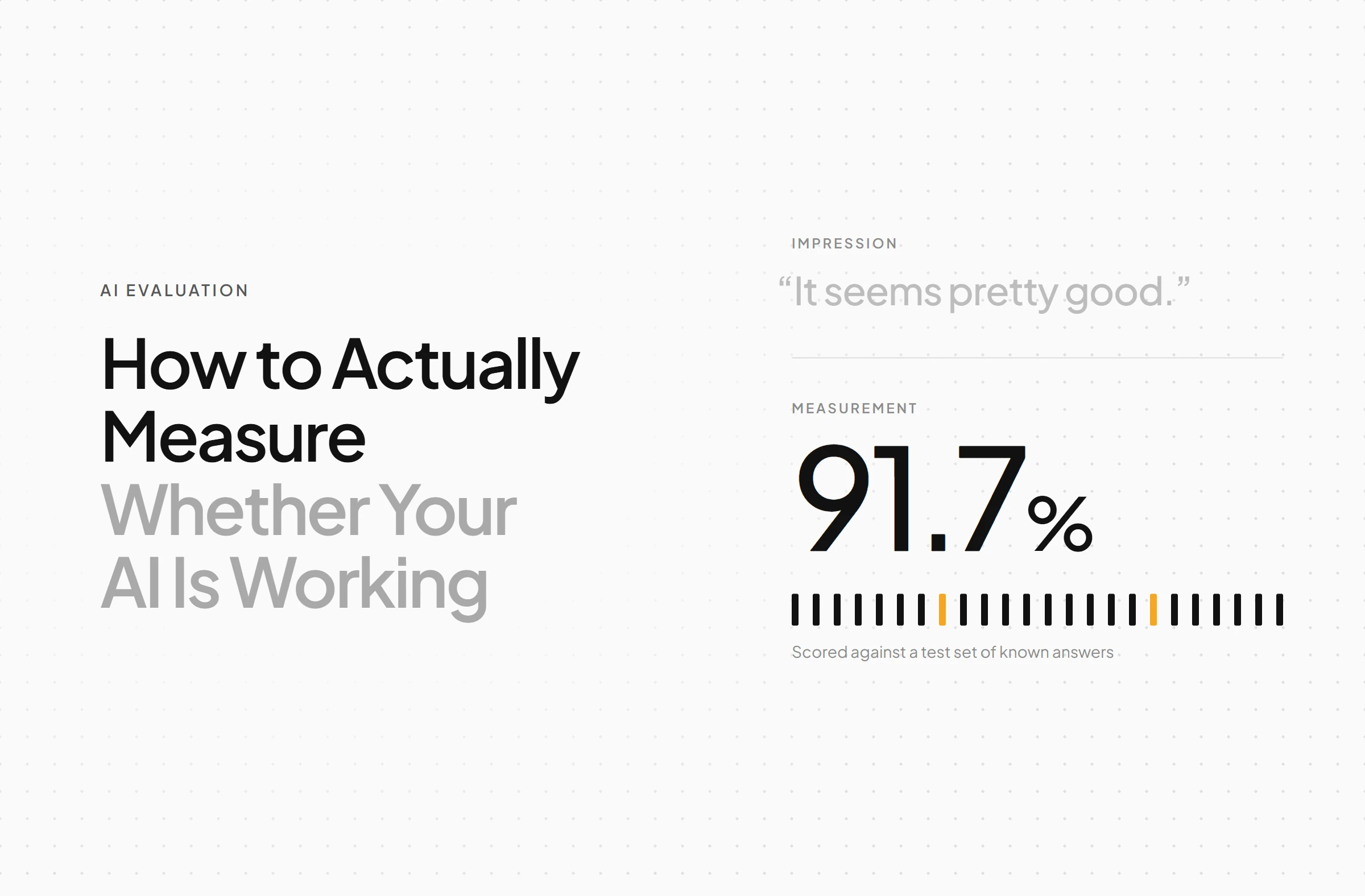
Ask most teams how accurate their AI system is, and you’ll get an impression rather than a number: “it seems pretty good,” or “we haven’t had complaints.” That’s not measurement, it’s a vibe, and vibes don’t hold up when a customer disputes a decision or a board member asks for evidence the investment is paying off.
Real measurement requires a specific, unglamorous piece of infrastructure: a test set of examples with known correct answers, sometimes called a golden dataset or ground truth set, that you can run your system against repeatedly and score objectively. Without this, you cannot tell whether a system is actually accurate, whether a change you made improved or hurt it, or whether a model provider’s latest update quietly degraded your results.
The traditional obstacle to building one of these is cost. Manually writing hundreds or thousands of question-and-correct-answer pairs, by hand, checked by a subject matter expert, used to take weeks or months, which is exactly why most teams skip it and rely on intuition instead. That constraint has genuinely changed. It’s now practical to generate large synthetic test sets automatically, and doing it well requires a specific process, not just asking a model to make up some test questions.
Start from your own real documents and data, processed in a way that preserves their structure rather than shredding them into disconnected fragments. Automatically generate a wide range of question types against that material: factual questions, comparative ones, questions that require connecting two pieces of information rather than looking up one fact. Then validate each generated example with multiple different models checking each other’s work, since models with different training approaches tend to fail on different things, and only keep the examples where several independent models agree. Finally, have a person manually check a small, statistically meaningful sample, typically in the low single-digit percent, to establish a real error rate rather than assuming the automated process is perfect.
The output is a test set that would have taken months to build by hand, produced in days, that a human has verified is actually trustworthy rather than just automatically generated. That’s a meaningfully different thing from either pure manual labeling or an unverified synthetic set with no quality control at all.
Once that test set exists, it becomes the foundation for almost everything else worth doing. You can measure your current accuracy honestly instead of guessing. You can test whether a cheaper model performs just as well on your specific task, which is how real cost savings get found rather than assumed. You can catch a regression the moment a model update causes one, instead of finding out from a customer complaint weeks later. And you can prove, with a number, to a compliance team or a skeptical executive, that the system does what you claim.
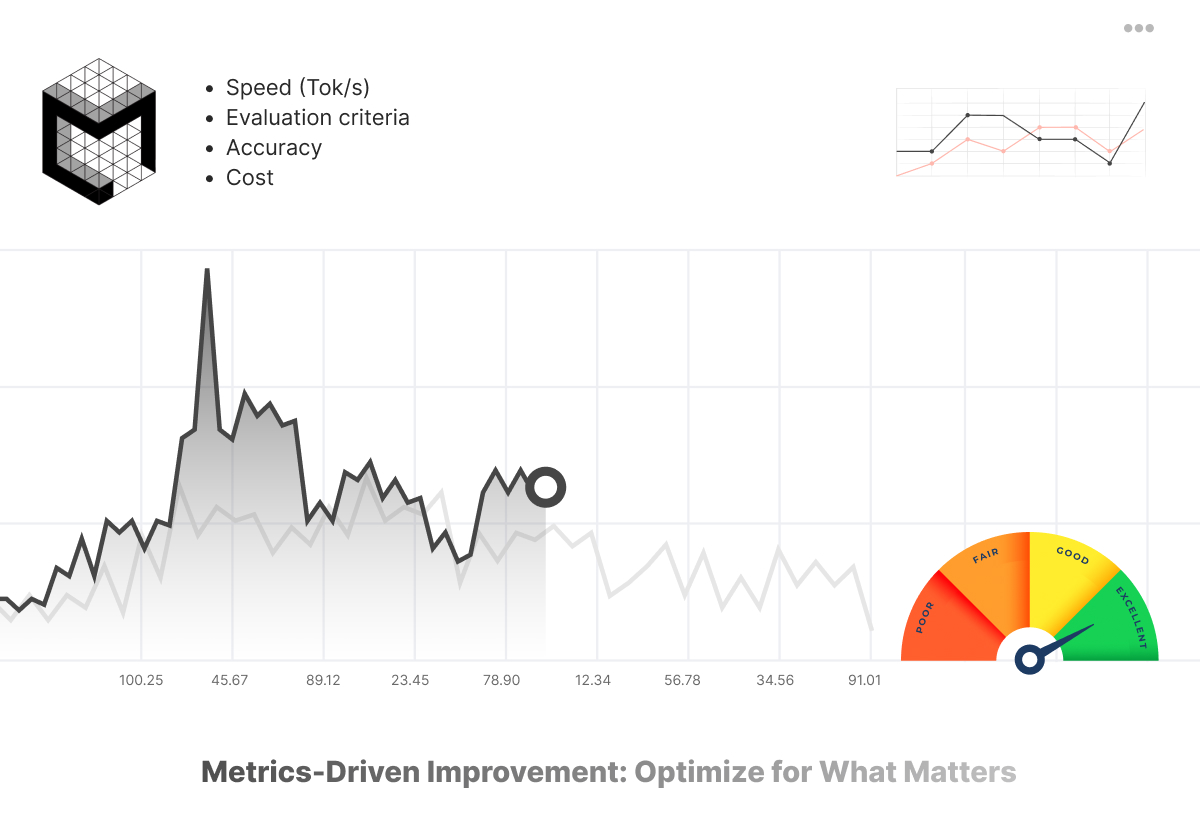
The teams treating AI accuracy as a real, ongoing measurement problem are quietly pulling ahead of the ones still treating it as a feeling. The tooling to close that gap without months of manual labor already exists. Most companies just haven’t built it yet.